

Description
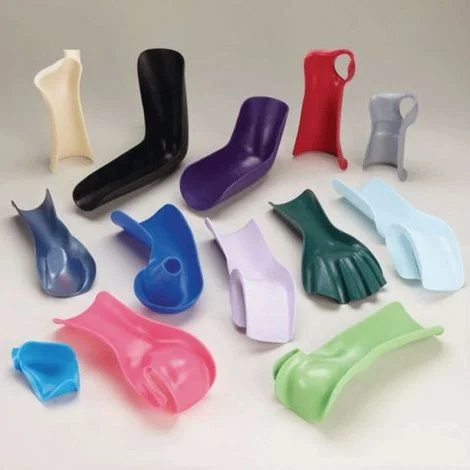
Rolyan Aquaplast-T Watercolors Metallic Blue Splinting Sheet is a moldable splinting material which has the optimum combination of intimate conformability and resistant stretch. 100% memory allows repeated reheating and economical splint revisions. Resoften the material and it will return to its original size and shape.
Features
- Rolyan Aquaplast-T Watercolors Metallic Blue Splinting Sheet provides superior ventilation for comfort while maintaining material strength
- Edges can be trimmed and finished easily
- For a temporary bond, pinch heated surfaces together
- For a permanent bond remove the coating with spirits or by safely scraping with a sharp instrument
- Latex free
More Information
- Precautions for Finished Orthoses:
– Splint adjustments are to be made only by a healthcare professional. The healthcare professional is responsible for providing wearing instructions and precautions to other healthcare practitioners, care providers involved in the patients care, and the patient.
– If unusual swelling, skin discoloration or discomfort occurs, use should be discontinued and a health care professional consulted - Patterning:
– Patterns can be drawn on all splinting materials with a scratch awl before placing the material in the water - Cutting:
– All splinting materials can be cut at room temperature by using heavy-duty shears, or scoring with a utility knife and bending at the scored mark, then completing the cut with a knife or scissors.
– If more detailed pattern-making is required, it is recommended that the pattern be transferred to the splinting material to make a rough blank. Then heat the rough blank for one-half the recommended time or until material is soft enough to cut with scissors.
– This method will reduce rough edges and save time with edge finishing.
– Light splinting materials can be cut at room temperature using scissors. - Heating: For Aquaplast splinting materials, use a heat pan liner in the bottom of the heat pan or frying pan.
– Hydrocollator units can be used for large pieces of splinting material.
– Use a heat pan liner to dip the material into the unit, to ensure that the material does not touch the bottom. Do not leave the splint blank unattended.
– In addition to hot water heating, Aquaplast materials can be heated in a convection oven
Note: that dry heating makes the material self-bonding, so no surface preparation is required for bonding. Material that is heated in the oven also becomes hotter than material heated in water; check temperature carefully before applying it to the patient. Heat material without overlapping or folding on a baking sheet with a non-stick surface in a preheated oven as follows.
– heat at 195° to 205°F (90°C to 95°C) for up to 10 minutes or until transparent or translucent
Technical Tip: To prevent hands from sticking to Original Aquaplast and Original Resilient, use cold cream or mineral oil on hands or dip hands in cold water. - Forming:
– When Aquaplast materials become transparent or translucent in a heat pan, the material is soft and ready to form.
– When the material is soft, remove it from the water and pat it dry with an absorbent towel. (To avoid towel impressions or lint, cover the towel with a pillow case before drying the splinting material.)
– Check the temperature of the material before beginning to fabricate the splint on the patient
Technical Tip: To prevent hands from sticking to Original Aquaplast and Original Resilient, use cold cream or mineral oil on hands or dip hands in cold water - Cooling:
– Cold water, cold packs, cold spray, or cold wraps can be used to speed the cooling process.
Technical Tip: Exercise band that has been stored in a freezer can also be used to speed the cooling process - Adjustments:
– Change in contour or design of the splint can be accomplished easily by spot-heating the area by pouring hot water over it or using a heat gun. Care should be taken not to overheat the material when using a heat gun
– keep the hot air stream of the heat gun moving and do not hold it too close to the material. - Edge Finishing:
– Smooth edges by heating the rough edges of the splinting material with a heat gun or dipping the edge into heated water for 5 to 10 seconds.
– Smooth the heated edges using finger tips or the palm of the hand small amount of hand or body lotion on the finger tips makes smoothing the edges easier. - Care and Cleaning:
– Splinting materials The shelf life of low-temperature splinting materials is indefinite under the following conditions:
– Store at temperatures between 40° and 90°F (4° and 32°C)
– Store at less than 65% relative humidity
– Avoid prolonged exposure to light, especially ultraviolet light
– Avoid exposure to corrosive fumes and ethylene oxide fumes. - Fabricated splints:
– The splint will lose its shape in temperatures over 135°F (57°C). It should be kept away from sources of heat such as ovens, hot water, open flames, and sunny car windows.
– The splint can be cleaned with soap and lukewarm water.
– The straps can be washed with soap and water, but the adhesive portion should not be moistened.
– The splint and straps should be allowed to dry thoroughly before reapplication of the splint.
Reviews
There are no reviews yet.